Hispanic or Latino
The US Census Bureau equates the two terms and defines them as referring to anyone from Spain and the Spanish-speaking countries of the Americas. After the Mexican–American War concluded in 1848, term Hispanic or Spanish American was primarily used to describe the Hispanos of New Mexico within the American Southwest.
› Hispanic_and_Latino_Americans
What is the racial wealth gap definition?
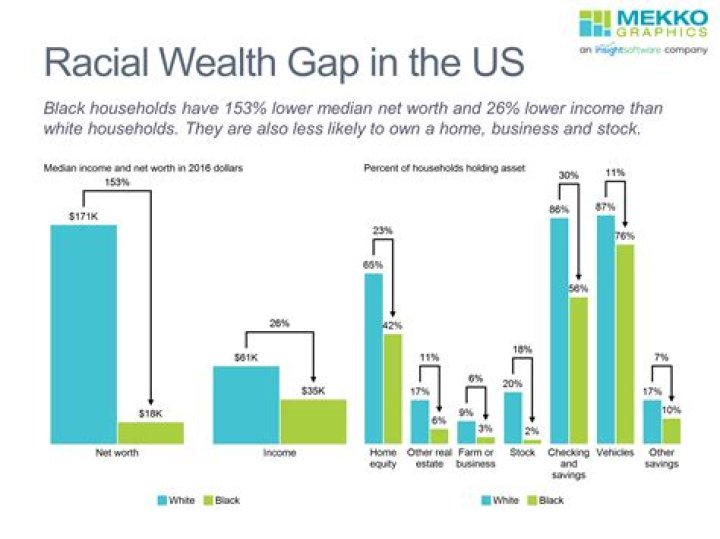
The racial wealth gap refers to the disparity in assets of typical households across race and ethnicity. The gap in assets is far wider than disparities in wages across races. Income inequality, housing policies, limited educational opportunities, and a lack of support structures contribute to the racial wealth gap.What is the racial wealth gap in the United States?
White Americans received a mean of $28,177 that accounted for 20.7% of their mean wealth while African Americans received a mean of $5,165 that accounted for 13.9% of their mean current wealth. Non-inherited wealth was more equally distributed than inherited wealth.What percent of US wealth is controlled by the 1%?
As of Q1 of 2021, the top 10 percent held 69.8 percent of total U.S. net worth (which is the value of all assets a person holds minus all their liabilities). The top 1 percent held about half of that wealth – 32.1 percent, while the next 9 percent held approximately another half at 37.7 percent.Who owns most wealth in America?
The top 1% owned a record 32.3% of the nation's wealth as of the end of 2021, data show. The share of wealth held by the bottom 90% of Americans, likewise, has declined slightly since before the pandemic, from 30.5% to 30.2%.Explained | Racial Wealth Gap | FULL EPISODE | Netflix
What percentage of the US is upper class?
The American upper class is estimated to include one to two percent of the population.Which race is the poorest in the US?
Poverty and race/ethnicityAs of 2010 about half of those living in poverty are non-Hispanic white (19.6 million). Non-Hispanic white children comprised 57% of all poor rural children.
What race has lowest income?
In terms of broad ethnic groups, Black Americans have consistently had the lowest median income in the given years, while Asian Americans have the highest; median income in Asian American households has typically been around double that of Black Americans.What percentage of black men make $100000?
Almost three-in-ten (28%) make $75,000 or more, including 18% that make $100,000 or more. The median household income for single-race Black households in 2019 is $43,200, meaning half of households headed by a single-race Black person earn more than that and half earn less.What percent of billionaires are white?
The total number of millionaires in the US is 20.27 million. There are 788 billionaires in the United States. There are 323,443 millionaire households in New Jersey. 76% of US millionaires are white.What race is the biggest consumer?
Black Buying PowerBlack people are major consumers in the American economy and spend more than $1 trillion a year on goods and services.
Which ethnic groups are most affected by income inequality?
Economic inactivity rates of some ethnic groups, like Bangladeshi (40%), Pakistani (38%) and Chinese (32%) ethnic groups, are higher than average (20%). This is largely because of high rates of economic inactivity among women from these ethnic groups.What is the cause of the racial wealth gap?
The current racial wealth gap is the consequence of many decades of racial inequality that imposed barriers to wealth accumulation either through explicit prohibition during slavery or unequal treatment after emancipation.Why is there a gap between rich and poor?
A major cause of economic inequality within modern economies is the determination of wages by the capitalist market. In the capitalist market, the wages for jobs are set by supply and demand. If there are many workers willing to do a job for a great amount of time, there is a high supply of labor for that job.What is the meaning of wealth inequality?
Wealth InequalityWealth refers to the total amount of assets of an individual or household. This may include financial assets, such as bonds and stocks, property and private pension rights. Wealth inequality therefore refers to the unequal distribution of assets in a group of people.